
Season 1 Guide
Last War Season 1 RA Virus Guide: Infection, Resistance, Weather, Cures, and Base Safety
A detailed Last War Season 1 RA Virus guide covering infection, Virus Resistance, weather effects, cures, Permeate, and the best ways to avoid costly mistakes.
RA Virus is one of the most important Season 1 systems because it changes how you approach both PvE and base management. It is not just a background mechanic. It directly affects your damage, troop safety, rally efficiency, and even how dangerous it is to move around the map while infected.
Many players only notice RA Virus when their damage suddenly drops or when Virus Stacks start piling up faster than expected. That usually happens because they underestimate Virus Resistance, ignore weather effects, or do not understand how infection spreads through base movement and combat. If you want to play Season 1 efficiently, you need to understand the full system early.
Key takeaways
- Virus Resistance matters more than raw power when fighting infected seasonal enemies.
- Weather can increase virus pressure, reduce march speed, or make infected movement safer depending on the condition.
- Permeate makes infected bases dangerous because outgoing teams carry part of the base's Virus Stacks with them.
- Manual cures from allies are much more reliable than waiting for slow passive recovery.
Profession quick pick
Engineer
Best for most players
Choose Engineer if your focus is efficient growth, better upgrade pacing, and stronger long-term account value.
- F2P friendly
- Better resource efficiency
- Useful alliance support value
War Leader
Best for aggressive PvP
Choose War Leader if you plan to lead rallies, fight constantly, and trade long-term efficiency for stronger combat impact.
- Better for whales and rally leads
- Stronger offensive pressure
- Higher value in active war play
1. What RA Virus Actually Does in Season 1
In Season 1, fighting certain enemies can infect your troops. This includes targets such as Zombies, Corruptors, Wanted Bosses, and infected troops. If your Virus Research Institute is not upgraded enough, your infection builds up as Virus Stacks.
Virus Stacks are the core of the system. The more stacks you carry, the worse the consequences become. At low levels, the effect may look manageable. At high levels, your account becomes much less efficient and your base becomes a much bigger liability.
This is why RA Virus is not just a combat problem. It is a progression problem. If you ignore resistance upgrades and keep taking infected fights carelessly, you lose damage, suffer stronger debuffs, and create extra risk for your alliance.
- Battles against infected seasonal enemies can add Virus Stacks.
- Low Virus Resistance makes infected fights much less efficient.
- High stack counts create both combat and base-management problems.
2. Why Virus Resistance Matters More Than Raw Power
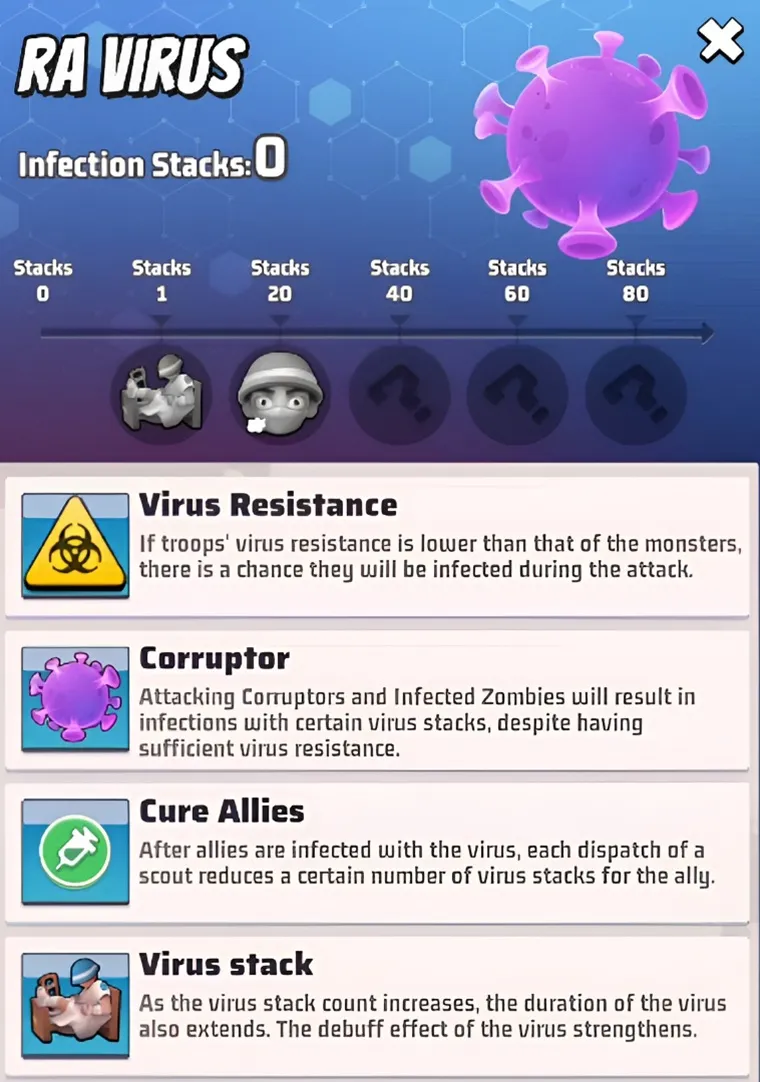
The single most important defensive stat in this system is Virus Resistance. When the enemy's Virus Level is higher than your Virus Resistance, your damage dealt is reduced. In practice, this means you can look powerful on paper and still perform badly against infected targets if your resistance is too low.
The game shows this directly in the attack window. If the required resistance is much higher than what you currently have, your damage penalty can be severe. That is why some players feel like they suddenly cannot kill seasonal enemies efficiently even though their troop power looks fine.
The practical lesson is simple: raw power is not enough in Season 1. You need enough Virus Resistance to actually convert your account strength into real damage.
- Always check required Virus Resistance before attacking infected enemies.
- Do not assume squad power can compensate for low resistance.
- Upgrade the Virus Research Institute steadily instead of treating it as a side system.
3. How Virus Stacks Build Up and Why They Become Dangerous
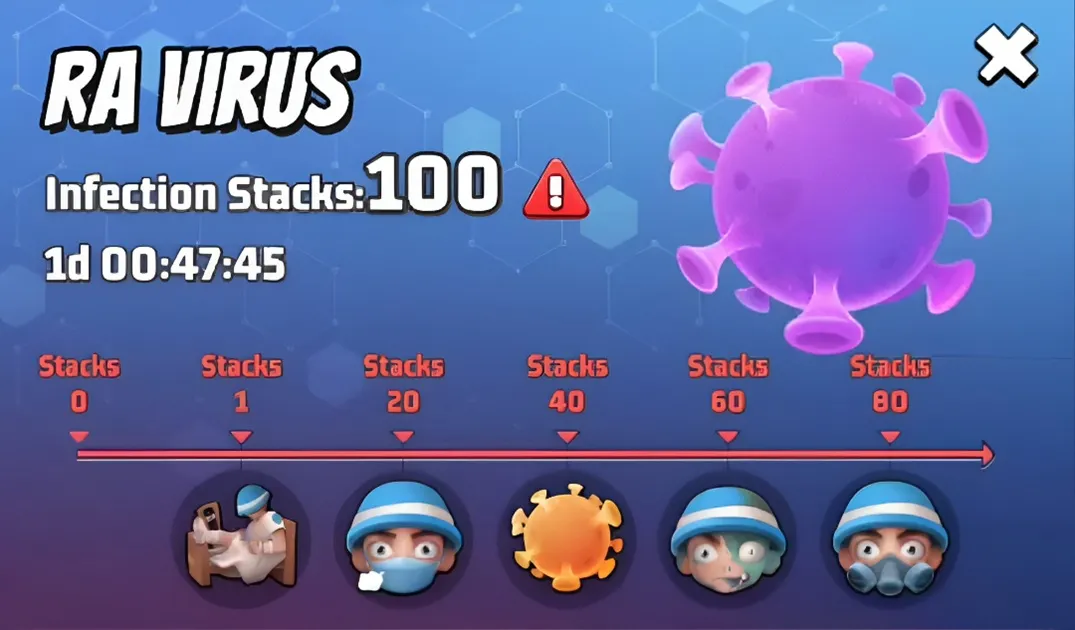
Every infected fight can add Virus Stacks. One of the key visual signals is the +1 Virus icon after battle, which means one Virus Stack has been added automatically. The number may seem small at first, but repeated PvE farming can build stacks quickly, especially if you are attacking enemies above your resistance comfort level.
This creates a snowball effect. Low resistance makes fights less efficient, less efficient fights often mean more repeated attempts, and more attempts create more Virus Stacks. Those extra stacks then trigger heavier debuffs that make the next fights even worse.
At higher thresholds, RA Virus becomes much more than a damage problem. It can affect wounds, offensive output, infection spread, and eventually create serious base-level consequences if you let stacks climb too far.
| Virus Stack Threshold | Main Effect |
|---|---|
| 1 | Hospital-related penalty begins. |
| 20 | Damage dealt reduction becomes noticeable. |
| 40 | Enemy losses increase. |
| 60 | You can infect the enemy even if defeated. |
| 100 | Maximum danger level and the harshest consequences. |
4. New Zombie Combat Types Change PvE Planning
RA Virus also ties into one of the biggest Season 1 PvE changes: infected enemies are no longer all functionally the same. Some zombies now have combat types, which means your lineup choice matters much more than it did before.
The guide highlights Tank, Aircraft, and Missile enemy categories. If you keep sending one standard squad into every infected fight, you will lose more troops and waste more stamina than necessary.
This matters even more when your Virus Resistance is already behind. The wrong troop type plus a low-resistance penalty is one of the fastest ways to turn a manageable infected fight into a bad trade.
- Adapt troop composition to the infected enemy type whenever possible.
- Do not use one lazy PvE march for every seasonal fight.
- Type mismatch and low resistance together create very poor efficiency.
5. What to Do If Your Virus Resistance Is Too Low
If your Virus Resistance is below the requirement, the best answer is usually not brute force. The smarter move is to use alliance support and reduce the burden on your own troops.
Ask allies with higher resistance to help kill infected targets. In many cases, it is better to join a rally efficiently than to waste troops trying to force solo progress. This is especially true when the reward matters more than personal credit.
Season 1 often rewards teamwork over ego. If your goal is to unlock stages, collect rewards, and preserve troops, alliance support is often the most efficient solution.
- Ask higher-resistance allies for help instead of forcing low-efficiency fights.
- Use rallies to reduce your own losses when resistance is behind.
- Prioritize efficient clears and progression over solo pride.
6. Weather Effects Can Make RA Virus Better or Worse
Weather adds another layer to the RA Virus system, and good players pay attention to it before moving, farming, or fighting. Weather changes every 1 to 4 hours, and the forecast can show multiple possible conditions with different probabilities.
Some weather conditions directly increase virus pressure, while others improve farming value or reduce how dangerous infected movement becomes. That means weather is not cosmetic. It changes the safety and efficiency of your decisions.
- Light Rain is especially useful because troops cannot carry Virus Stacks.
- Acid Rain can create virus pressure even when you are not actively fighting.
- Windy can ruin rally timing, reinforcement speed, and farming routes.
| Weather | Effect |
|---|---|
| Acid Rain | Periodically adds Virus to all bases in the War Zone. |
| Brumeux | Monsters start with +2 Virus Stacks. |
| Windy | March Speed -30%. |
| Sunny | +30% Profession EXP when killing monsters. |
| Rainbow | All commanders gain regular Profession EXP. |
| Light Rain | Troops cannot carry Virus Stacks. |
| Cloudy | Neutral weather. |
7. Permeate: Why an Infected Base Is More Dangerous Than It Looks
One of the most important advanced RA Virus mechanics is Permeate. When a base is infected, outgoing teams carry 25% of that base's Virus Stacks with them.
This turns infection into a movement problem, not just a stationary base problem. Even if you think your troops are only leaving the base for a routine task, they may already be taking virus pressure with them.
Once your base is infected, every outgoing march needs more attention. If you keep moving troops carelessly, you can spread the problem instead of containing it.
- An infected base affects outgoing teams, not just the base itself.
- Permeate makes routine marches riskier than many players expect.
- Contain infection before resuming normal movement patterns.
8. How Infection Spreads During Base Combat
The guide also explains what happens when a base is attacked while infected. This is one of the easiest ways for players to create expensive problems without realizing it.
The result depends on the target's defensive state. If there is no defense, infection is transmitted. If there is defense but no troops, there is no transmission. If there is both defense and troops, the carried Virus Stacks are transmitted.
That means infected players should think carefully before entering base fights. Under the wrong conditions, normal combat can spread RA Virus instead of solving anything.
| Target State | Transmission Result |
|---|---|
| No defense | Infection is transmitted. |
| Defense but no troops | No transmission. |
| Defense plus troops | Carried Virus Stacks are transmitted. |
9. Cures: How to Recover Before the Debuffs Become Severe
There are two main cure methods shown in the guide. Manual Cure lets an ally send an aircraft to remove 1 Virus Stack. Auto Cure slowly reduces Virus Stacks if no new infections occur.
The problem is that Auto Cure is very slow. It is helpful for light cleanup, but it is not a reliable answer when your stack count is rising quickly or when you are already carrying serious debuffs.
That is why active communication matters. If your stacks are building fast, ask for cures through alliance chat before the problem becomes expensive.
- Manual Cure removes 1 Virus Stack through ally support.
- Auto Cure is passive but slow.
- Do not wait too long to ask for help if stacks are climbing.
10. Best Practices and Common Mistakes to Avoid
RA Virus rewards disciplined play. The strongest Season 1 players are not just the ones with the biggest accounts. They are the ones who manage resistance upgrades well, fight infected targets efficiently, use alliance support intelligently, and avoid spreading infection through careless movement.
Most major RA Virus mistakes are very predictable. Players treat Virus Resistance as optional, ignore the weather, let Virus Stacks rise too high before asking for cures, or keep attacking infected content blindly because their normal squad power looks strong.
If you want one simple rule to remember, use this one: never attack infected content blindly. Check your Virus Resistance, check the weather, check your stack situation, and only then commit troops.
- Upgrade the Virus Research Institute consistently.
- Check weather before major movement, PvE sessions, or rally windows.
- Ask for cures early instead of waiting for severe debuffs.
- Be careful with auto-rally situations that can create extra losses and Virus Stacks.
- Treat infected base movement as a risk until the condition is under control.
Keep reading
More Season 1 guides
Previous guide
LastWar Season1 Quick Guide
A complete Season 1 guide to the virus system, new resource loop, Virus Resistance, map conquest rules, and the path toward the City of Apocalypse.
Next guide
Season 1 Week 1 Guide
A detailed first-week Last War Season 1 guide covering the virus action cycle, The Purge, Serum Collection, weather tactics, and Kimberly's Rocket Shadow unlock.